
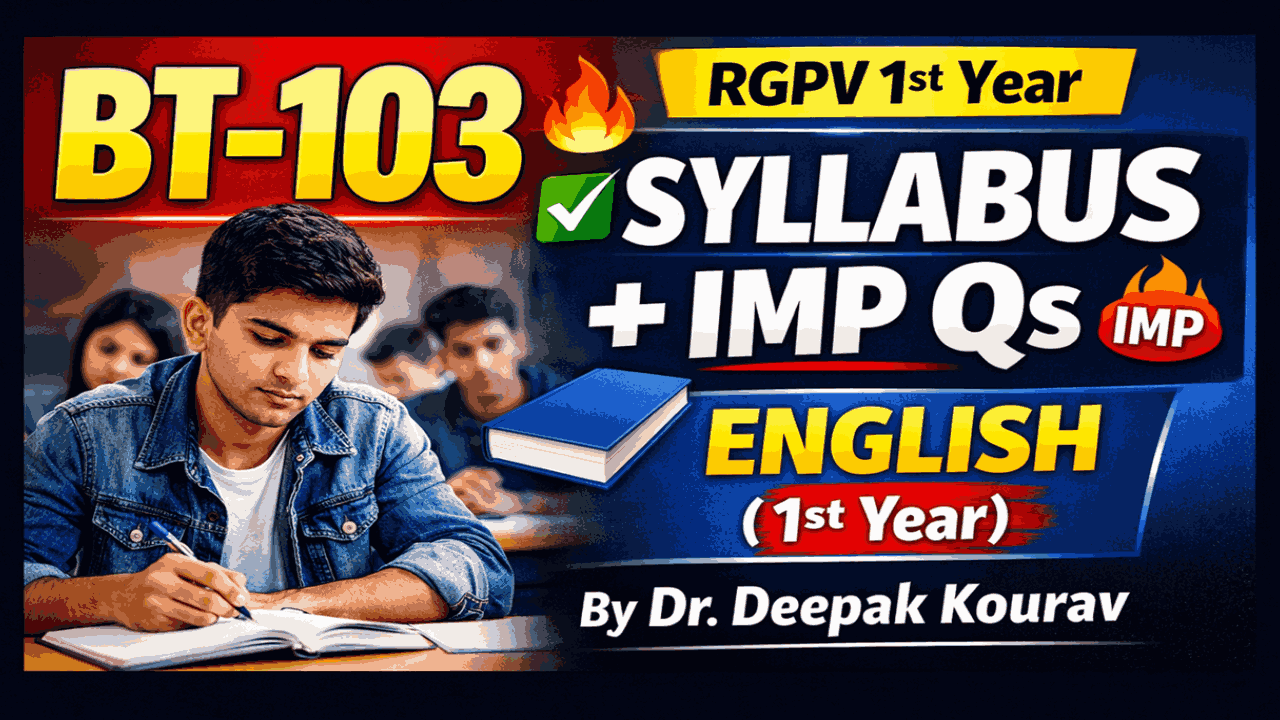
BT-103 English for Communication is very important subject for students of RGPV affiliated institutes. It is designed to improve the communication skills of students it is basically focused on grammar, vocabulary, writing, speaking, and professional communication.
Course objective of BT-103 English for Communication
The language laboratory focuses on the practice of English through audio-visual aids and Computer software. It intends to enable the students to speak English correctly with confidence and intends to help them to overcome their inhibitions and self –consciousness while speaking in English.
Topics to be covered in the Language laboratory sessions:
- Listening Comprehension
- Pronunciation, Intonation, Rhythm
- Practising everyday dialogues in English
- Interviews.
- Formal Presentation
Course Outcomes
The student will acquire basic proficiency in English including reading and listening comprehension, writing
and speaking skills.
Unit- I
Identifying Common errors in writing: Articles, Subject-Verb Agreement, Prepositions, Active and
Passive Voice, Reported Speech: Direct and Indirect, Sentence Structure.
Unit-II
Vocabulary building and Comprehension: Acquaintance with prefixes and suffixes from foreign languages in English to form derivatives, synonyms,
antonyms, Reading comprehension.
Unit-III
Communication: Introduction, Meaning and Significance, Process of Communication, Oral and Written Communication, 7 c’s of Communication, Barriers to Communication and Ways to overcome them, Importance of Communication for Technical students, nonverbal communication.
Unit -IV
Developing Writing Skills: Planning, Drafting and Editing, Precise Writing, Précis, Technical definition and Technical description. Report Writing: Features of writing a good Report, Structure of a Formal Report, Report of Trouble, Laboratory Report, Progress Report.
Unit -V
Business Correspondence: Importance of Business Letters, Parts and Layout; Application, Contents of good Resume, guidelines for writing Resume, Calling/ Sending Quotation, Order, Complaint, E-mail and Tender
Books Recommended
- ‘Technical Communication : Principles and practice’, Meenakshi Raman and Sangeeta Sharma (Oxford).
- ‘Effective Business Communication’, Krizan and merrier (Cengage learning).
- ‘Communication Skill, Sanjay Kumar and pushlata, OUP2011.
- “Practical English Usage Michael Swan OUP, 1995.
- “Exercises in spoken English Parts I-III CIEFL, Hyderabad, Oxford University Press.
- On writing well, William Zinsser, Harper Resource Book 2001.
- Remedial English Grammar, F.T. Wood,Macmillan2007.
Important Questions of BT-103 English for Communication
Q1. Answer the following as per direction given in brackets:
- Nishkarsh is playing football. (Change into passive Voice)
- He said ,”His horse died in the night.” (Change into Indirect speech)
- She said.” Oh no! I missed the train.” (Change into Indirect speech)
- They were doing good work. (Change into passive Voice) V
- Sam has written a letter. (Change into passive Voice)
- Hesaid, “Ihave lost my mobile phone.” (Change into indirect speech)
- “Why haven’t you phoned me?” he asked me. (Change into Indirect speech)
Q2. Choose the correct form of the verb that agrees with the subject.
- Mathematics (is, are) John’s favorite subject, while Civics (is, are) Andrea’s favorite subject.
- Eight dollars (is, are) the price of a movie these days.
- (Is, Are) the tweezers in this drawer.
- Your pants (is, are) at the cleaner’s. V
- There (was, were) fifteen candies in that bag. Now there (is, are) only one left!
- The committee (debates, debate) these questions carefully.
- Either my shoes or your coat (is, are) always on the floor.
Q3. Answer the following.
- Write down the Antonyms- Knowledge, better, regular, defensive, mortal, casual, include.
- Write down the Synonyms- Amazing, Begin, Clam, Delicious, Gross, Mischievous, Scared
Q4. On the basis of your reading of the passage answer the following questions.
Robert Bruce was the King of Scotland. He had made many efforts to free his country but in vain. One day he was sitting in a cave in a dejected mood. He was thinking to give up attempts to liberate his country. All of a sudden his eyes fell upon a spider that was trying to reach the ceiling. It made, several attempts but every time it failed. But the spider did not lose heart. It made a fresh attempt. To the great surprise and joy of Robert Bruce this time its attempt was crowned with success Bruce was now full of praise for the patience shown by the spider. He felt inspired and began to think that if a spider could be successful after making several unsuccessful attempts, why couldn’t he? He mustered up courage and made another attempt. This time he was successful in freeing his country.
Answer the following questions.
- Why was Robert Bruce sitting in a dejected mood?
- What did Robert Bruce notice about the spider?
- Why was Robert Bruce surprised?
- How did the Robert Bruce feel inspired? V
- What did he decide to do?
- What was the result of his attempt?
- Pick out the words/phrases from the passage which mean the same as:
1) Useless
2) Give up courage
3) Liberate
Q5. Describe the process/cycle of Communication. Give difference between one -way Communication and two- way Communication?
Q6. Explain the advantages and disadvantages of written communication.
Q7. Give difference between laboratory report and progress report.
Q8. What do you mean by planning drafting and editing? What are the stages of planning drafting editing?
Q9. Write a contents of a good resume in details.
Q10. What do CC and BCC mean? What are the basics of email? Explain.
Q11. Draft a tender notice for construction of a workshop building of a new polytechnic costing Rs. 80 lakhs, assume suitable information if required.
Q12. Give the difference between calling quotation and sending quotation in detail.
Q13. What is technical definition and technical description? What are technical definition terms? Explain.
Q14. What is report writing? What are the structural features of report writing?
Q15. . Explain the following.
a) Non verbal Communication
b) Complaint
C) Laboratory Report
d) Precise Writing
You Should also read this:
RGPV First Year Syllabus of BT-102 Mathematics-I
RGPV Syllabus of BTech First Year BT-101 Chemistry
Visit official website of RGPV for more information: Click here